

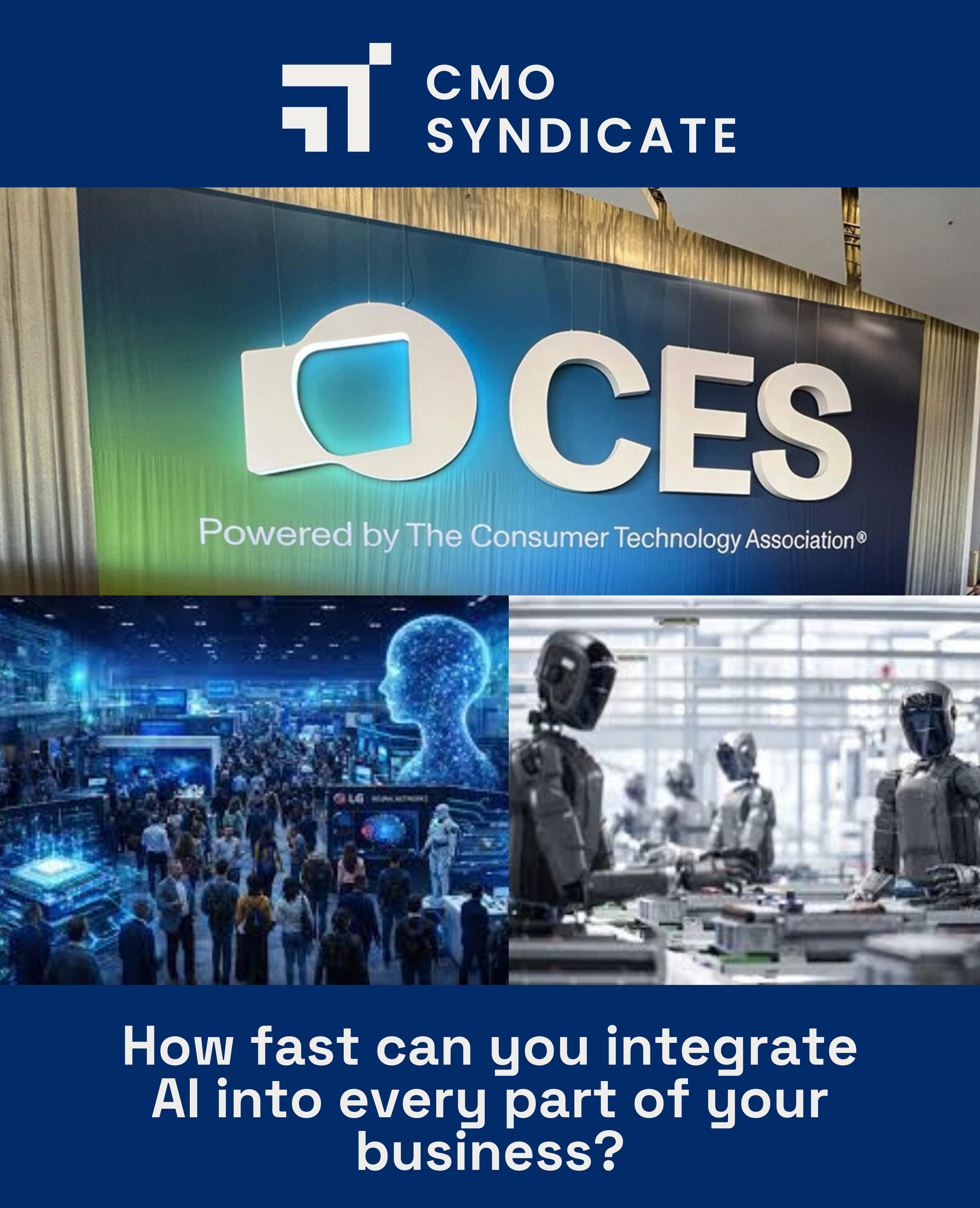
CES 2026
By: Jean Foster, The CMO Syndicate
January is all about CES and the tech trends shaping every industry, from mining and farming to how we manage our health, and the cool TVs, of course.
This year, I got to head back to Las Vegas for my10th CES. As always, it did not disappoint.
While everyone loves to focus on the latest gadgets, the real story this year was that Agentic AI is here, and Physical AI is knocking on our door.
Just 1 year ago, at CES 2025, I, along with 8,000 attendees, pulled out our phones when NVIDIA CEO Jensen Huang showed a chart with the evolution from generative AI to agentic AI and physical AI.
That move has happened quickly, from abstract promises to tangible products, driven by AI agents, which you can purchase today.
The Drum summed it up best.
Key Takeaways
- AI inside everything
While most of us have incorporated GenAI solutions in everyday life, the biggest dynamic is the move from GenAI apps and standalone solutions to being embedded in enterprise software. This will accelerate adoption at scale.
- Agentic AI is here and being deployed
Systems that go beyond responses and chatbots to performing tasks with no or limited human intervention were everywhere, from advertising to agriculture.
- Physical AI is right behind it
Robots have always been a fixture of CES, from Sony’s super cute Aibo in 2018 to Open Droid’s cocktail-making robot in 2025. AI gives these humanoid robots more utility. But there is a way to go.
LG’s laundry folding robot has promise, but it’s a bit clunky and slow. The real innovation is in industrial applications, such as the Boston Dynamics Atlas robot designed for use in manufacturing.
- Precision AI
As generative AI becomes ubiquitous, we are finding the pitfalls. Not surprisingly, a lot of the discussion was around precision AI in areas that require absolute accuracy for safety. Healthcare is one. One company, Humetrix, which offers AI-powered healthcare solutions for large entities, including the US government and the Paris Olympics, showcased medical translation solutions that are powered by precision AI using small language models. If we are using AI in healthcare, I need it to be private, secure, and hallucination-free.
- The fun stuff
Finally, CES would not be CES without the TVs and gadgets.
- LG’s super sleek Wallpaper W6 OLED, only 9mm thick!
- For the kids, Lego’s Smart Play. Lego bricks are getting a glow-up with sensors and speakers for interactive play. This will be fun.
Final Thoughts: What This Means For Businesses
- AI is no longer optional
It’s business critical. Companies that fail to integrate AI into their core business risk falling behind. AI is no longer an experiment; it’s core to business strategies.
- Agentic AI is being deployed
The technology is not the hard part. An organization’s ability to re-tool their business and operations processes will be the limiting factor to realizing the power it can enable.
- 3. Physical AI will reshape industries
The fusion of AI with robotics, self-driving vehicles, and industrial automation will disrupt traditional business models. Leaders must start thinking about how automation will impact their workforce and operations.
My Takeaway: AI has grown up. Now it’s time to act.
AI has moved from the future into the present. For CEOs, the question is no longer “Should we adopt AI?” but rather “How fast can we integrate AI into every part of our business?”
The companies that move decisively will be the ones that lead their industries into the next era of intelligent business.
How We Can Help
The CMO Syndicate is helping clients reimagine their businesses in planning, implementing, and scaling AI solutions to accelerate business growth.
📩 Contact us here to learn more.
Leave A Reply