

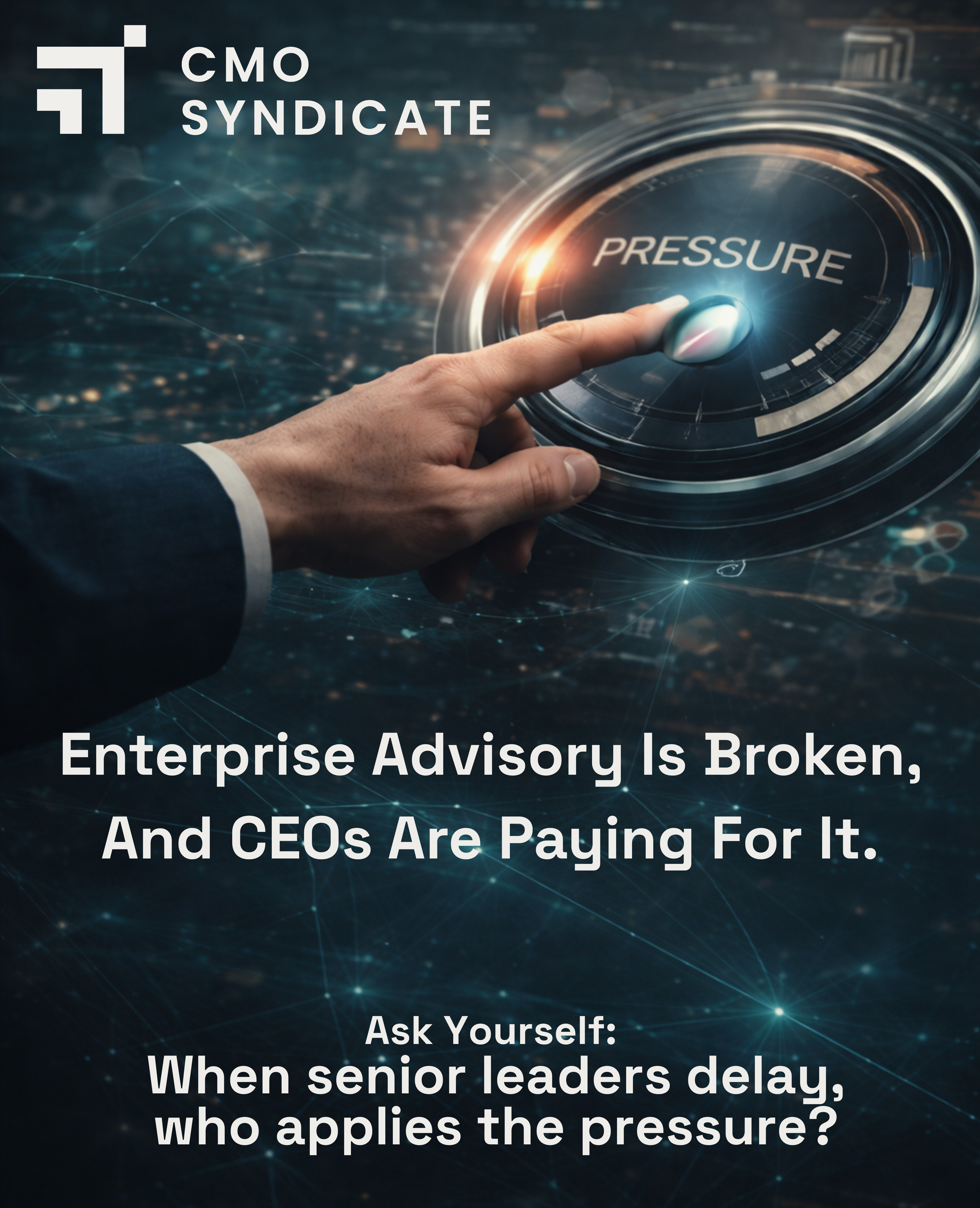
Enterprise Advisory Is Not Strategy Decks. It’s Decision Pressure.
By: Lisa Bratkovich, Ani Matson, & Jennifer Welch, The CMO Syndicate
Most CEOs don’t lack strategy. They lack pressure at the right moments.
In enterprise and private-equity-backed B2B companies, strategy is rarely absent.
What’s absent is decision pressure, the kind that forces clarity when information is incomplete, incentives are misaligned, and delay feels safer than action.
We see this repeatedly in companies between $50M and $1B in revenue. The leadership team is experienced. The board is engaged. The decks are solid.
Yet growth slows, confidence erodes, and execution drifts. Not because the strategy was wrong, but because no one applied pressure when it mattered.
Advisory fails when it informs instead of forcing decisions
Most enterprise advisory work optimizes for insight, not outcomes.
Leadership teams are shown:
- Market trends
- Competitive shifts
- Technology implications
- Strategic options
All of which are useful. None of which are decisive.
The uncomfortable reality is this: Insight without consequence changes nothing.
When advisory input doesn’t force trade-offs, reallocation, or accountability, it becomes intellectual cover for inertia. Everyone feels informed. No one feels compelled.
CEOs don’t need more perspective; they need someone who sharpens the moment of decision.
Alignment is overrated when accountability is unclear
One of the most persistent enterprise myths is that alignment drives execution. In practice, alignment often masks avoidance.
Marketing aligns with sales. Sales aligns with finance. Finance aligns with the board. Product aligns with the roadmap.
Everyone agrees until a real decision appears:
- Do we stop funding this segment?
- Do we reset pricing where margins are leaking?
- Do we pull back from growth bets that look good on paper but drain capacity?
- Do we admit this leader is out of their depth?
Alignment dissolves the moment trade-offs become personal. At that point, execution doesn’t stall because people disagree. It stalls because no one has the authority, or mandate, to force resolution.
The real enterprise risk: decisions get delayed, not debated
In most stalled growth situations, the problem isn’t that leadership teams make bad decisions. It’s that they don’t make them fast enough.
Delay shows up quietly:
- “Let’s wait for one more quarter of data.”
- “We’ll revisit this after budgeting.”
- “We need more consensus.”
- “This isn’t the right time to disrupt the team.”
Meanwhile:
- Customers move on
- Margins erode
- AI reshapes expectations
- Talent loses confidence
- Boards grow impatient
The cost of delay compounds faster than the risk of being imperfect. Enterprise advisory that doesn’t surface this cost explicitly is incomplete.
Where theory breaks down and judgment matters
Enterprise environments are messy by definition:
- Data is fragmented
- Incentives conflict
- Politics exist
- Execution capacity is finite
This is where theory stops helping. Frameworks don’t tell you:
- Which initiative to kill when everything looks “strategic”
- How to challenge a senior leader without destabilizing the team
- When alignment is sufficient, and when it’s an excuse
- How much ambiguity is tolerable before confidence breaks
Only judgment does. And judgment doesn’t come from analysis alone. It comes from having been accountable for outcomes, not recommendations.
CEOs must personally own commercial truth or it fragments
One of the most dangerous patterns we see is the diffusion of commercial truth.
Marketing owns customer insight.
Sales owns pipeline.
Finance owns forecasts.
Product owns usage and roadmap.
No one owns commercial reality as a whole. When this happens, decisions default to:
- The loudest function
- The most politically protected initiative
- The least disruptive option
CEOs cannot outsource this integration. If commercial truth doesn’t sit at the CEO level, or isn’t forcefully synthesized for them, decision quality degrades, even in otherwise strong organizations.
What must change tomorrow (not next quarter)
This isn’t about adding process. It’s about changing behavior. Three shifts matter immediately:
- Treat indecision as a risk, not neutrality
If a decision can materially affect growth, margin, or credibility, delay should require justification, not action.
- Separate insight from action explicitly
Every strategic conversation should end with:
- What changes?
- Who owns it?
- What stops if this moves forward?
If nothing changes, the conversation was informational, not advisory.
- Apply pressure where incentives are weakest
Execution fails where incentives are misaligned. That’s where pressure belongs, not where it’s already easy.
The quiet role CEOs underestimate
The most effective enterprise leaders don’t just set direction. They create productive discomfort at the right moments.
They:
- Ask the question that collapses debate
- Force prioritization when teams want optionality
- Make trade-offs explicit
- Push decisions through organizational drag
They don’t confuse calm with control. And they don’t rely on advisory input that stops short of execution reality.
A final thought
If your organization is smart, aligned, and still slower than it should be, the issue isn’t capability. It’s pressure.
Specifically: who applies it when decisions stall.
The difference between companies that regain momentum and those that drift is rarely strategy. It’s whether someone is willing, and empowered, to force clarity when it’s uncomfortable.
That is the work that actually moves enterprises forward.
And it’s where experienced, execution-led partners make the difference.
📩 Contact us here to learn more.
About the Authors
Ani Matson
Partner, The CMO Syndicate
Ani is an interim CMO and commercial advisor specializing in enterprise growth execution, operating model design, and board-level decision support across B2B and private equity–backed companies.
Lisa Bratkovich
Partner, The CMO Syndicate
Lisa brings deep experience in revenue transformation, pricing strategy, and go-to-market execution for complex B2B organizations navigating scale, integration, and exit readiness.
Jennifer Welch
Partner, The CMO Syndicate
Jennifer is a global marketing and commercial strategy leader with hands-on experience aligning growth strategy to execution across multi-region, PE-backed enterprises.
Leave A Reply