

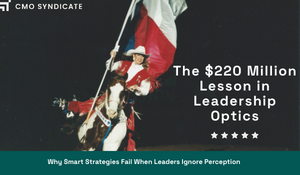
The $220 Million Lesson in Leadership Optics: Why Smart Strategies Collapse When Perception Turns Against You
What a high-profile government controversy teaches CEOs about credibility, symbolism, and the hidden risks of leadership messaging.
Leaders rarely lose credibility because of strategy. They lose it because of optics. We see this pattern repeatedly inside companies where the strategy may be sound but the symbolism undermines the message.
If you are a CEO, you already know this uncomfortable truth -
Your strategy may be right. But, if the optics are wrong, the strategy will fail anyway.
This week provided a very public example.
After a series of controversies surrounding a $220 million advertising campaign and other spending decisions, the Secretary of Homeland Security was removed from her position. (NBC News Report)
For CEOs and leadership teams, the situation is less about politics and more about what it reveals: how quickly optics can overwhelm even a defensible strategy.
The political debate will continue.
But for leaders, the more interesting question is not political.
It is strategic.
How did the optics overwhelm the message?
Executive Brief
The leadership lesson behind the headlines
-
Leaders rarely lose credibility because of strategy - they lose it because of optics.
-
When leaders become the central character of a campaign, audiences often interpret the message as self-promotion rather than mission.
-
Symbolism matters: stakeholders judge leadership visually and emotionally before they evaluate results.
-
Once perception turns against a leader, the conversation shifts from “Is the strategy working?” to “Why are they doing this?”
When Messaging Becomes Self-Promotion
One of the central controversies involved a large advertising campaign encouraging undocumented immigrants to voluntarily leave the United States.
The campaign reportedly cost more than $200 million and prominently featured the Secretary herself speaking directly to viewers on horseback, which wasn't really germane to the topic. (reported by NBC News.)
From a marketing perspective, this created an immediate risk.
When the leader becomes the primary face of a campaign, audiences often interpret the message as personal branding rather than institutional communication.
That perception can overwhelm the underlying objective.
Symbolism Matters More Than Leaders Expect
The controversy deepened when reports surfaced that DHS was seeking approval to purchase a luxury aircraft equipped with bedrooms, showers, and high-end interior design - which officials said could be used for deportation flights and cabinet travel.
Whether or not the purchase made operational sense quickly became irrelevant.
The symbolism told a different story.
A luxury aircraft associated with deportation operations created a visual contradiction that critics quickly seized upon. (NBC News report )
As someone who actually grew up around horses and ranch culture, I understand why leaders sometimes use cowboy imagery to signal grit or toughness.
Those symbols can be powerful.
But audiences are remarkably good at sensing the difference between authenticity and performance.
When symbolism feels staged rather than earned, credibility disappears quickly.
The Leadership Lesson
Inside companies, we see this pattern constantly.
The strategy may be rational.
The numbers may work.
But the optics signal something different to stakeholders.
When that happens, leaders lose the narrative.
And once the narrative shifts, the strategy rarely survives intact.
What CEOs Should Take From This
Three leadership rules apply across politics, business, and institutions.
1. Your campaign is about the mission - not you.
If the leader becomes the story, credibility erodes quickly.
2. Symbolism matters more than spreadsheets.
People evaluate leadership visually and emotionally before they evaluate outcomes.
3. Stakeholders interpret signals you did not intend to send.
Every message, image, and decision communicates something.
Leaders who ignore optics eventually lose control of the story.
Close
The lesson is simple but uncomfortable:
You can have the right strategy and still lose the narrative.
Because leadership is not judged only by results.
It is judged by how the results look.
And in public leadership - corporate or political - optics often decide which strategies survive.
The real question leaders should ask themselves is this:
If someone saw our strategy from the outside, would the optics reinforce the message we want them to believe?
Because leadership is not just about getting the strategy right.
It’s about making sure the story your strategy tells is the one you intended.
And yes, I shamelessly used a horse picture of myself to get your attention, but I didn’t spend $220 million on this blog either (maybe in horse feed over the years, but we’ll save that for another time.)
About the Author
Jennifer Layne Welch
Partner, The CMO Syndicate
Jennifer Layne Welch is a growth architect for ambitious businesses. With more than 30 years of experience, she helps organizations scale faster, align leadership teams, and transform marketing into a commercial growth engine.
Jennifer advises founders, C-suite leaders, and private equity-backed teams on how to evolve from reactive tactics to strategic growth systems that drive revenue, strengthen reputation, and accelerate results.
Sources referenced
- NBC News reporting on DHS advertising campaign
- NBC News reporting on DHS aircraft procurement proposal
- Congressional hearing coverage
Leadership Optics FAQ
What are leadership optics?
Leadership optics refer to how a leader’s decisions, communications, and symbolism are perceived by stakeholders, often influencing credibility as much as actual outcomes.
Why do optics matter in strategy?
Even strong strategies can fail if the messaging, imagery, or leadership behavior contradict the mission stakeholders expect to see.
How can CEOs avoid optics failures?
Leaders should ensure that communications, symbolism, and strategic messaging reinforce the same narrative they want stakeholders to believe.
Leave A Reply